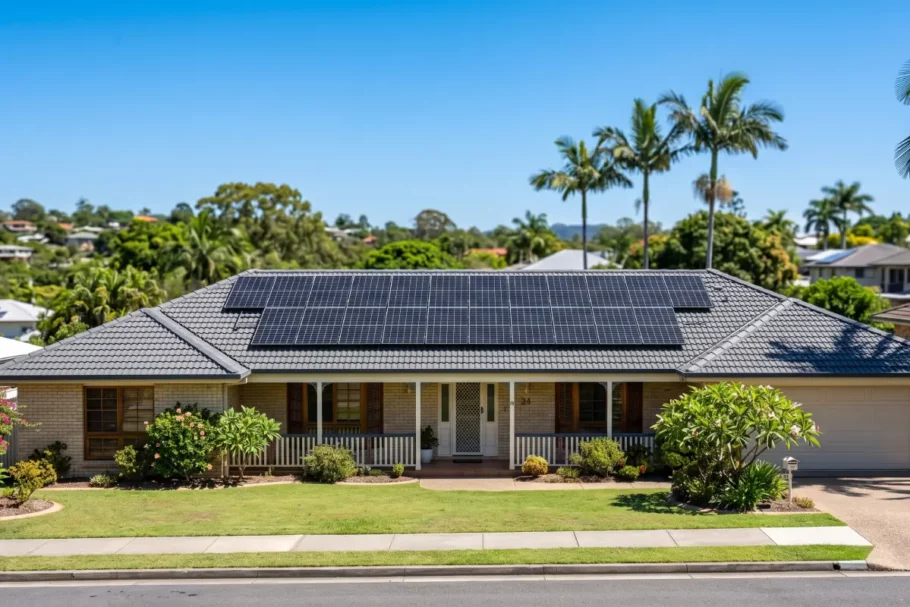
A 6.6kW system in Brisbane runs about $4,500 to $7,500 after the federal STC discount, and Queensland adds no state rebate on panels.
Quick answer: A 6.6kW solar system in Brisbane costs about $4,500 to $7,500 fully installed in 2026, with the federal STC rebate already taken off the price. Queensland adds no state rebate on panels, and that federal discount shrinks every January.
Key takeaways
- A typical 6.6kW system runs $4,500 to $7,500 in Brisbane after the rebate, near $5,730 on average.
- The only discount on panels is the federal STC. There is no Queensland state top-up.
- The rebate drops each January as the scheme winds toward its 2030 close, so waiting costs you.
- Low local feed-in rates mean your savings come mostly from using your own power by day, not exporting it.
On this page
- The short answer on price
- System prices by size
- What the rebate is, and what it is not
- Why Queensland has no state rebate on panels
- Where your money actually goes
- Adding a battery: the federal rebate
- Feed-in tariffs and payback
- How to get a quote you can trust
- The bottom line
- Frequently asked questions
Queensland has the best rooftop solar conditions in the country, at 5.2 to 5.5 peak sun hours a day, so the payback case stays strong. Getting the numbers right still matters, because quotes for the same system routinely differ by a thousand dollars or more.
This guide covers what you pay by system size, how the rebate lowers that price, why waiting costs you, and what shifts your quote up or down.
The short answer on price
Most Queensland homes install a 6.6kW system, and after the federal rebate, that lands around $5,000 to $6,000, with Brisbane at the lower end. Solar Choice put the average Brisbane 6kW system near $5,730 in early 2026.
Prices run low here for two reasons. Strong installer competition keeps margins tight, and high sun hours mean each kilowatt earns more rebate certificates.
The useful benchmark is price per watt. A quality installed system in 2026 costs about $0.88 to $1.30 per watt after the rebate, including GST.
System prices by size
The table shows typical fully installed Queensland prices with the federal STC discount already applied. Premium panels and inverters push costs 20 to 30 percent above these ranges.
| System size | Installed price (after STC) | Price per watt | Best suited to |
| 5 kW | $3,500 – $5,500 | ~$0.90 – $1.20 | Smaller homes, 1 to 2 people |
| 6.6 kW | $4,500 – $7,500 | ~$0.90 – $1.15 | The default 3 to 4 person household |
| 10 kW | $8,000 – $11,000 | ~$0.88 – $1.10 | Larger homes, pool, or an EV coming |
| 13.2 kW | $10,000 – $14,000 | ~$0.85 – $1.10 | High usage, battery, or three-phase homes |
Size to your usage, not to your roof space. A 10kW system only beats a 6.6kW one financially if you use the extra generation directly or store it. Export it at a low feed-in rate and the premium takes far longer to repay.
What the rebate is, and what it is not
The “solar rebate” is not a payment you apply for, it is a point-of-sale discount already baked into your quote. Your system generates Small-scale Technology Certificates, your installer claims and sells them, and the value comes off the price.
The Clean Energy Regulator runs the scheme, the Small-scale Renewable Energy Scheme. It closes on 31 December 2030, and it pays less each year until then.
How the STC discount is calculated
Three numbers set your rebate: your zone rating, the deeming period, and your system size. The formula is zone rating x deeming period x system size in kW, which gives your certificate count. Multiply that by the STC price, which trades around $36 to $40 against a $40 cap.
Brisbane’s zone rating is about 1.382, and in 2026 the deeming period is 5 years. A 6.6kW system earns roughly 45 to 46 certificates, worth about $1,400 to $1,850 off the price. A 10kW system earns around 69 certificates, roughly $2,100 to $2,800.
Because the value floats with the certificate market, the exact rebate on your quote varies between installers and between months.
Why waiting costs you
On 1 January 2026, the deeming period dropped from 6 years to 5. That alone cut about $500 to $600 off a typical 6.6kW rebate compared with 2025.
It drops again every January: 4 years in 2027, then 3, 2 and 1, until the scheme ends. Panel prices are not falling fast enough to offset that, so each year you wait, you pay more net.
Why Queensland has no state rebate on panels
Queensland has no state solar-panel rebate in 2026, so the federal STC is the only incentive that lowers your panel price. This trips up buyers who plan for a state discount stacked on top of the federal one.
State support here targets batteries and legacy feed-in arrangements, not panels.
Treat a quote “with no rebate” with suspicion in the other direction too. A quote shouting about a large rebate may simply be showing the STC discount it already subtracted, so compare final installed prices, not headline discounts.
Where your money actually goes
Two systems of the same size can differ by thousands, and the drivers are predictable.
Panel tier sets the base. Budget Tier 1 panels from brands like Jinko or Trina run $80 to $150 each, while premium REC, SunPower or Tindo modules sit at $250 to $300 plus.
Inverter choice is the next big lever. A single string inverter is cheaper, while microinverters cost more but handle shade and per-panel monitoring better. On a 10kW system, going micro can add $1,500 or more.
Your roof and connection matter too. A steep or tile roof, multiple roof faces, a switchboard upgrade, or a three-phase connection all raise labour and hardware costs.
Adding a battery: the federal rebate
The federal Cheaper Home Batteries Program takes roughly 30 percent off an eligible battery install, and it is now the main storage incentive in Queensland. It launched on 1 July 2025 and extended an STC-style discount to home storage for the first time.
From 1 May 2026, the discount moved to a tiered structure, worth about $250 per usable kilowatt-hour on the first 14kWh. Systems from 5kWh up to 100kWh qualify, with only the first 50kWh of usable capacity eligible. The battery must be VPP-capable and on the Clean Energy Council’s approved list.
The battery discount steps down twice a year, on 1 January and 1 July, with the next cut due in January 2027. Queensland’s own Battery Booster closed to new applications back in May 2024, so the federal program is now the one that applies.
A 10kWh battery in Brisbane runs somewhere around $8,650 before the federal discount, which is why storage still adds years to a payback rather than shortening it for most homes.
Feed-in tariffs and payback
A feed-in tariff is what your retailer pays for exported power, and Queensland splits into two very different zones.
South-east Queensland, on the Energex network covering Brisbane, the Gold Coast and the Sunshine Coast, has no mandated minimum. Retailers set their own rates, from about 4c to 13c per kWh in 2026, usually with a daily export cap. Regional Queensland, on the Ergon network, has a regulated rate of 8.66c per kWh for 2025 to 26.
Because export rates are low and grid power costs 30c to 50c at peak, self-consumption now drives payback more than the feed-in rate. Using your own solar during the day is worth far more than exporting it.
For a well-sized system with good daytime use, payback in Queensland typically runs about 4 to 7 years, against a panel lifespan of 25 years or more. Households that export most of their generation sit at the longer end.
One legacy note: the old 44c Solar Bonus Scheme, closed to new customers since 2012, runs until 1 July 2028 for those still on it. Adding a battery can affect that arrangement, so existing 44c customers should confirm the rules in writing first.
How to get a quote you can trust
Get at least three written quotes, because price gaps of $1,000 to $2,500 for the same system are common. Work through this checklist before you sign anything:
- Get three itemised written quotes and compare final installed prices, not headline rebates.
- Check each quote names the panel brand and model, the inverter brand and model, and the capacity in kW.
- Confirm the installer is Clean Energy Council accredited, which is a condition of the STC rebate.
- Read independent reviews from more than one source.
- Ask one blunt question: will your own employed technicians install it, or do you subcontract the job?
If you want a Brisbane-based starting point for comparison, Solar Power Systems Brisbane is worth checking alongside your quotes.
The bottom line
Solar in Queensland is cheaper than most of the country, and the honest headline for 2026 is a range, not a single number. A typical 6.6kW system costs about $4,500 to $7,500 in Brisbane after the federal STC discount, moving with panel tier, inverter type, roof complexity and your installer.
The discount that lowers that price is the federal STC alone. Queensland adds no state rebate on panels, and the federal discount shrinks each January as the scheme winds down to its 2030 close, so waiting generally means paying more.
Batteries carry their own federal discount of roughly 30 percent but still lengthen payback for most homes. Solar works best alongside everyday energy saving tips, since cutting daytime consumption further extends how much of your own generation you use directly rather than exporting it cheaply.
With low local feed-in rates, your savings come mostly from using your own power by day. Size the system to your usage, get three itemised quotes from accredited installers, and the maths works in your favour across a 25-year system life.
Frequently asked questions
How much does a 6.6kW solar system cost in Brisbane?
A 6.6kW system in Brisbane costs about $4,500 to $7,500 fully installed in 2026, with the federal STC discount already applied. The average sits near $5,730, and premium equipment pushes the price higher.
Does Queensland have a solar rebate in 2026?
For panels, the only rebate is the federal STC discount, applied at the point of sale. Queensland has no state rebate on solar panels, and its state support is directed at batteries instead.
Are solar panels worth it in Queensland in 2026?
For most homes, yes. Queensland’s high sun hours and rising grid prices give a typical system a 4 to 7 year payback against a 25 year lifespan, though the return depends on how much power you use during daylight.
Should I wait for prices to drop before buying?
Waiting usually costs more, not less. The federal rebate shrinks every January as the deeming period falls, and panel prices are not dropping fast enough to make up the difference.
How many solar panels do I need?
Size to your electricity use, not your roof. A 3 to 4 person household usually fits a 6.6kW system, while homes with a pool, an EV, or a battery often move up to 10kW or more.